How to read efflorescence on new pavers.
That white chalky haze on your new patio isn’t damage. It’s calcium working itself out of the concrete. Here’s what to do (usually nothing) — and when to actually worry.
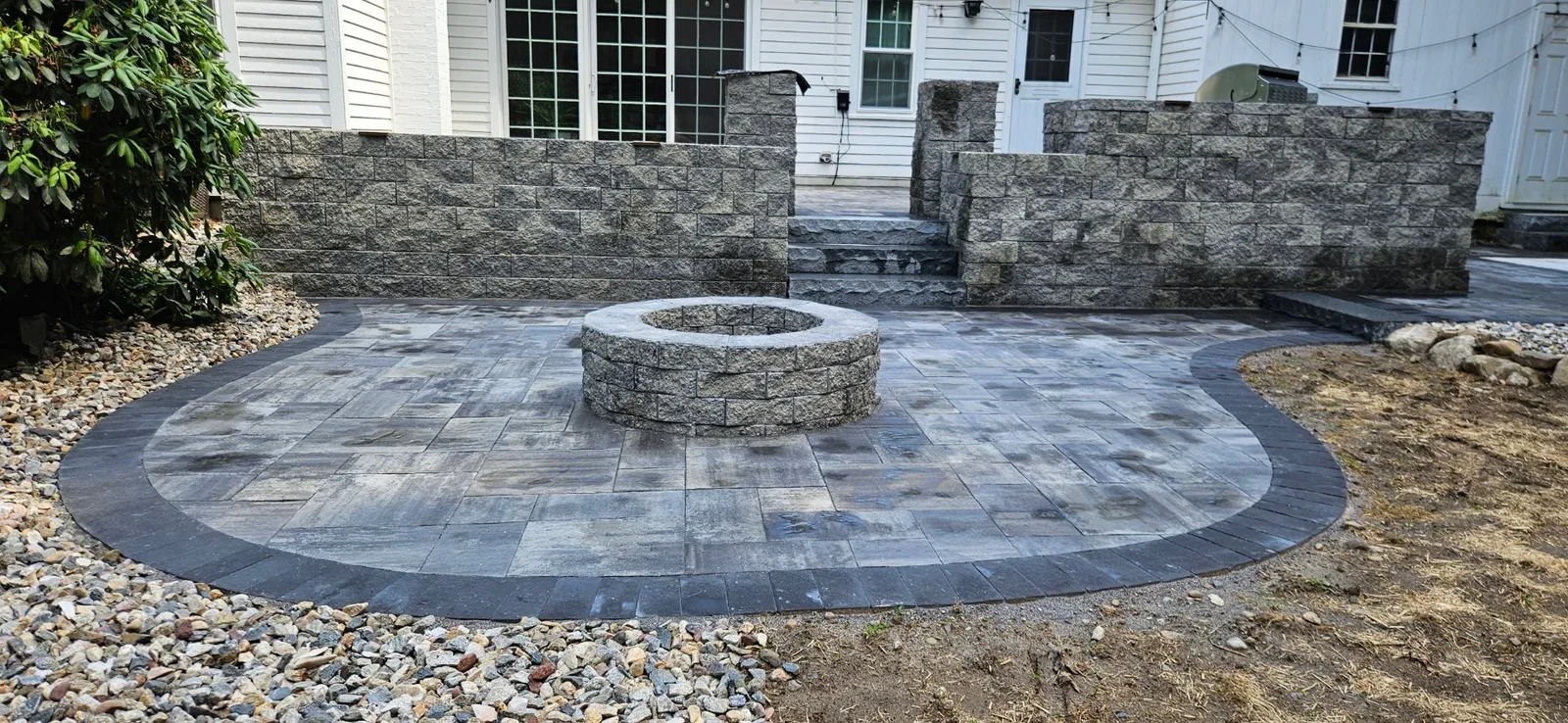
You paid good money for a new patio, walked out one morning, and found a white chalky haze spreading across the pavers like someone dusted them with powdered sugar. Before you call anybody or grab a scrub brush, take a breath. That haze isn't damage, it isn't a stain, and it isn't a sign somebody cut corners on your job. It's calcium doing exactly what calcium does in fresh concrete. Here's how to read it, what to do about it (usually nothing), and how to tell it apart from the problems that actually need attention.
What efflorescence actually is
Concrete pavers are made with cement, and cement carries free calcium hydroxide inside it. When moisture moves through a fresh paver — rain, dew, groundwater wicking up from below — it dissolves some of that calcium and carries it to the surface. The water evaporates, the air goes to work, and the calcium reacts with carbon dioxide to form calcium carbonate. That's the white film you're looking at. Same mineral as chalk, same mineral as the hard water spots on your shower glass.
It shows up most in the first few months after a patio or walkway goes in, because that's when the paver still has the most free calcium to give up. It's more visible on dark pavers than light ones, and it tends to look worse after a wet stretch followed by fast drying. None of that means anything went wrong. Efflorescence is a known, natural part of how new concrete behaves. It is not a defect, it is not the installer's fault, and no reputable manufacturer will call it one.
Why doing nothing is the right first move
The good news is that efflorescence is temporary. Once the paver has released the loose calcium near its surface, there's nothing left to migrate up, and the haze stops coming back. Weather does the cleanup for you: rain rinses the surface, foot traffic scuffs it, and the sun and air keep working on it. In most cases it fades away on its own somewhere in the range of six to eighteen months. On a busy front walk it can be gone by the next spring. On a quiet corner of a patio it might linger a little longer.
So the honest answer to "what should I do" is, at first, nothing. Let it run its course. We know that's not a satisfying answer when you're staring at a brand-new patio that looks cloudy, but reaching for the wrong fix early is how a cosmetic phase turns into an actual problem.
Efflorescence is the patio finishing a job the factory started. Give it a few seasons and the weather does the work for free.
The mistakes that make it worse
Impatience is the enemy here. A few common "fixes" do more harm than the haze ever would:
Aggressive pressure washing. Blasting a new paver at close range with a high-pressure tip can etch the surface, strip the fine cement paste, and blow the sand out of your joints. You trade a haze that would have vanished on its own for a permanently rougher, blotchier surface.
Harsh acid too early. Muriatic acid and other strong acids can burn a fresh paver, pull color out of it, and — this is the part people don't expect — actually pull more calcium to the surface, so the efflorescence comes back stronger. Acid on new pavers is how a lot of homeowners turn one white patch into a whole mottled patio.
Sealing too soon. A sealer looks like it would lock the problem away. It does the opposite. If you seal over a paver that still has calcium working its way out, you trap that moisture and mineral under the coating, and now the haze is stuck behind a film you can't rinse. Pavers need time to cure and release before any sealer goes down.
If you truly can't wait
Sometimes there's a wedding, a party, or just a homeowner who can't stand looking at it. If you have to act, do it the right way. Once the pavers have had time to cure — not the first week — you can use a cleaner made specifically for efflorescence, following the manufacturer's directions to the letter. These are formulated to break down the calcium carbonate without cooking the paver the way raw acid does. Test it on a small, out-of-the-way spot first, wet the surface as directed, don't leave it sitting longer than the label says, and rinse thoroughly.
Even then, understand you may be treating the same spot more than once as new calcium keeps surfacing over the following months. That's normal. The cleaner speeds up cosmetics; it doesn't stop the underlying process until the paver is done releasing.
The crew's rule
White haze on new pavers, wait. Green or black slime, act. Efflorescence weathers off on its own; mold, settling, and washed-out joints only get worse if you ignore them. When in doubt, hose it down — if it rinses lighter and keeps fading week to week, it's efflorescence and you leave it alone.
When to actually worry
Efflorescence is harmless. But a few things can hide behind that same general "my patio looks off" feeling, and those do need attention. Here's how to tell them apart:
- White that never fades. Efflorescence gets lighter over the seasons. If a heavy white deposit is still just as strong well past the first year and hasn't budged with rain and traffic, it's worth having someone look at drainage — persistent efflorescence usually means water is constantly moving up through the base and feeding it.
- Green or black growth. Efflorescence is dry, powdery, and whitish. Mold and mildew are green, black, or dark gray, they feel slimy when wet, and they make the surface slippery. That's an organic problem, not a mineral one, and it calls for a proper cleaning and a look at why the area stays damp and shaded.
- Settling or heaving. If pavers are sinking, tilting, or lifting so the surface is no longer flat, that's the base or the freeze-thaw cycle at work, not calcium. Uneven pavers are a trip hazard and a sign the foundation under them needs repair.
- Joint sand washing out. If the sand between your pavers is disappearing, leaving open gaps and loose stones, water is running across or under the patio in a way it shouldn't. That's a drainage and re-sanding job, and left alone it lets the whole field shift.
The pattern is simple. A white haze that lightens over time is doing what it's supposed to. Anything that stays the same or gets worse — slippery growth, movement underfoot, vanishing joints — is a real issue that won't fix itself.
The bottom line
That chalky film on your new patio is calcium finishing its work, not a flaw and not a failure. The best thing you can do is leave it alone and let a few seasons of Connecticut weather rinse it away. Skip the pressure washer, skip the acid, and don't seal until the pavers have had time to cure. If you can't wait, use a real efflorescence cleaner by the book. And keep an eye out for the things that actually matter — mold, movement, and washed-out joints — because those are the ones worth a phone call.
Thinking about a project this season?
Free, no-pressure on-site quotes across Hartford County, CT.
Let's build something that lasts.
Hardscaping, landscaping and snow removal across Hartford County, Connecticut. Licensed (HIC.0703177) and fully insured — free quotes on every project.