The best pavers for Connecticut's freeze-thaw winters.
The paver you pick matters — but the base under it matters more. Here’s what actually survives a Connecticut winter, and what spalls at the first hard freeze.
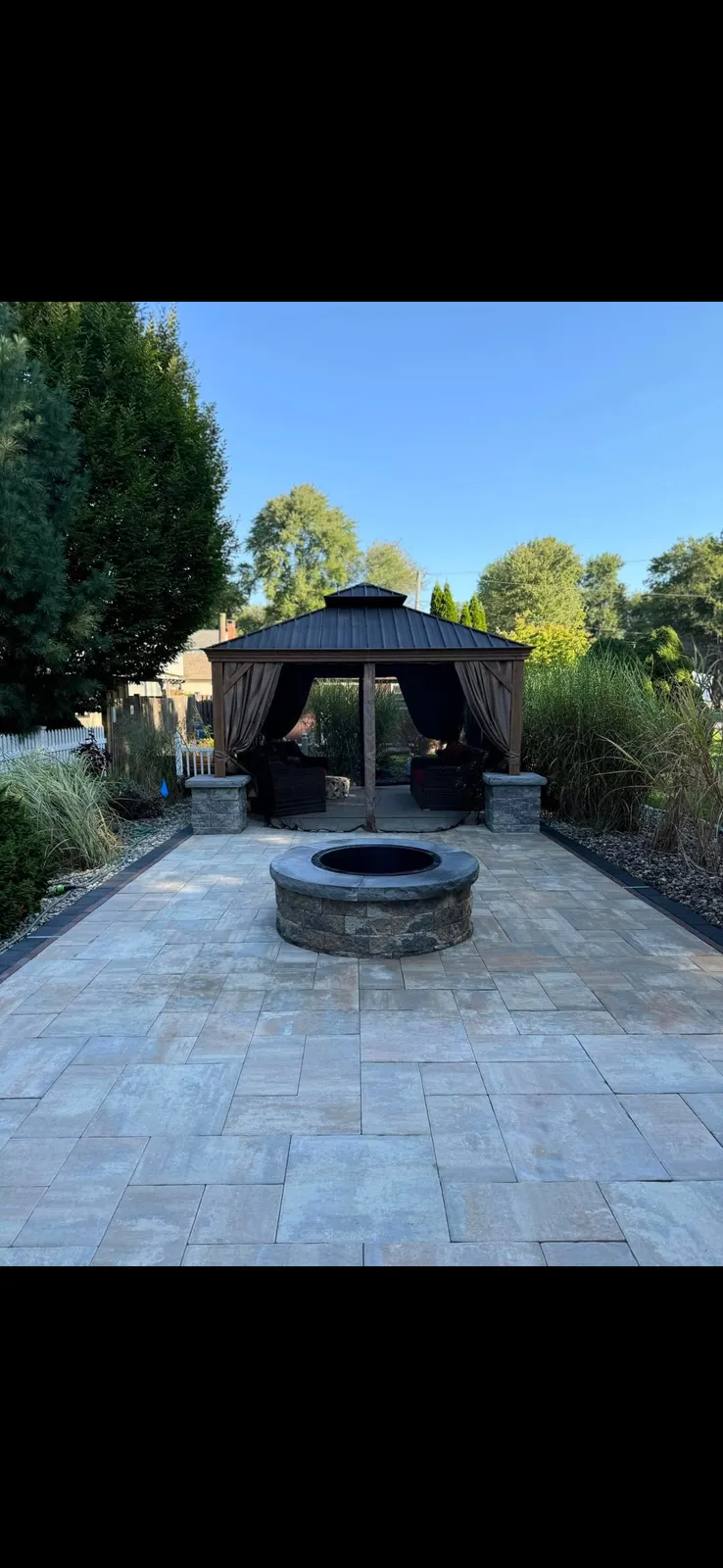
Every winter in Hartford County does the same thing to a patio or walkway: water soaks into the surface, freezes overnight, expands, then thaws by afternoon. Repeat that a hundred times between November and March and you find out fast whether your pavers were built for it. Here's how we pick pavers that hold up, and the one thing that matters more than the paver you choose.
What actually kills a paver in a Connecticut winter
It's not the cold. It's water. A paver that absorbs water is a paver that's going to spall, flake, and crack, because that trapped water freezes and expands by roughly nine percent every single night it drops below freezing. That expansion has to go somewhere, so it pushes the surface apart from the inside out. Do that over and over and even a nice-looking unit starts crumbling at the edges.
So when we talk about a "good" paver for New England, we're really talking about two numbers: high compressive strength and low water absorption. Strength keeps it from breaking under load and frost heave. Low absorption keeps the water from getting in to begin with. Modern engineered concrete pavers are built to hit both of those targets on purpose, which is why they've largely become the default around here.
Engineered concrete pavers: the workhorse
For most driveways, patios, and walkways in this climate, a quality engineered concrete paver is the smart, dependable choice. These aren't the gray squares from decades ago. Good manufacturers press them at high pressure, run tight water-absorption specs, and finish the top wear-layer to survive northern winters and de-icing.
Two names we build with regularly are Techo-Bloc and Nicolock. Both engineer paver systems specifically for freeze-thaw climates, and both give you a wide range of colors, textures, and shapes so you're not sacrificing looks for durability. We mention them as examples of the quality tier to shop in, not because a paver needs a certificate on the box. What you're looking for is a manufacturer that publishes real specs and stands behind them.
Natural stone: beautiful, durable, pricier
If your heart is set on natural stone, bluestone and granite are both gorgeous and genuinely tough. Granite in particular is dense and low-absorption, and full-color bluestone holds up well when it's the right grade. The trade-offs are real, though: natural stone costs more, and it's more variable piece to piece than a manufactured unit that's identical every time.
Porosity is the thing to watch. Some bluestone is more absorbent than people expect, and sealing can help slow water uptake and staining. If you go natural stone, plan on the higher price, expect some variation in color and thickness, and talk through sealing before the first winter rather than after it.
The best paver in the world, set on a thin, poorly compacted base, will still fail. The base under the paver beats freeze-thaw, not the paver itself.
Permeable pavers: when drainage is the problem
Sometimes the issue isn't the paver, it's the water that has nowhere to go. If you've got a spot that pools, a low patio, or a driveway that dumps runoff toward the house or the street, permeable pavers are worth a look. They're set with open joints and an open aggregate base that lets water pass straight through instead of sitting on top, freezing, and turning into a skating rink.
Less standing water on the surface means less freeze-thaw damage and fewer ice patches. Permeable systems need the right base build and some upkeep to keep the joints draining, but where drainage is the real enemy, they solve the actual problem instead of fighting it every winter.
Salt and ice-melt: go easy
How you clear ice matters as much as what you buy. Harsh chloride de-icers are rough on some surfaces, and they're especially hard on certain natural stone, where repeated salting can accelerate surface damage. Quality concrete pavers tolerate ice-melt better, but even there, more is not better.
- Use plain sand for traction when you just need grip, not melt.
- Reach for a paver-safe de-icer and use it sparingly, following the label.
- Avoid dumping rock salt and harsh chlorides, particularly on bluestone and other natural stone.
- Shovel first, treat second. Less product does the job when there's less ice to fight.
The base is the real answer
Here's the part that gets skipped, and it's the most important thing in this whole article. The paver you pick matters far less than what's underneath it. We've been called out to look at expensive pavers that heaved, sank, and cracked within a couple of winters, and almost every time the paver was fine. The base was the problem.
Freeze-thaw is beaten under the surface. That means a properly compacted aggregate base built to the right depth for the job, a driveway needs more than a walkway, compacted in lifts rather than dumped and leveled once. It means drainage and slope so water moves away instead of collecting under the pavers where it can freeze and lift them. Get the base right and an ordinary good paver lasts for decades. Get the base wrong and the finest paver on the market cracks anyway.
The crew's rule
Spend your money on the base, then on the paver, not the other way around. A good paver on a great base outlasts a great paver on a bad base every single winter.
What to avoid
A few things we steer people away from around here:
- Bargain, thin big-box pavers. They tend to run higher on water absorption and lower on strength, which is exactly backward for this climate.
- Clay brick used where it wasn't meant to go. It has its place, but the wrong application in freeze-thaw invites trouble.
- Anything with high water absorption, whatever it's made of. If the spec sheet doesn't reassure you, that's your answer.
- Skimping on base depth or drainage to hit a lower price. That's where the failures actually come from.
The bottom line
For a Connecticut freeze-thaw winter, buy a paver with high strength and low water absorption, quality engineered concrete like Techo-Bloc or Nicolock, or a good grade of natural stone if the budget allows, and consider permeable where drainage is the fight. Then treat it gently on ice, and above all, build it on a properly compacted, well-drained base. Do that and you'll get a patio or driveway that shrugs off the seasons instead of falling apart in them.
Thinking about a project this season?
Free, no-pressure on-site quotes across Hartford County, CT.
Let's build something that lasts.
Hardscaping, landscaping and snow removal across Hartford County, Connecticut. Licensed (HIC.0703177) and fully insured — free quotes on every project.