Patio vs. concrete: which is right for your Connecticut backyard?
Poured concrete is cheaper to pour. But New England freeze-thaw cracks slabs — and pavers move with the ground instead of fighting it. Here’s the honest comparison.
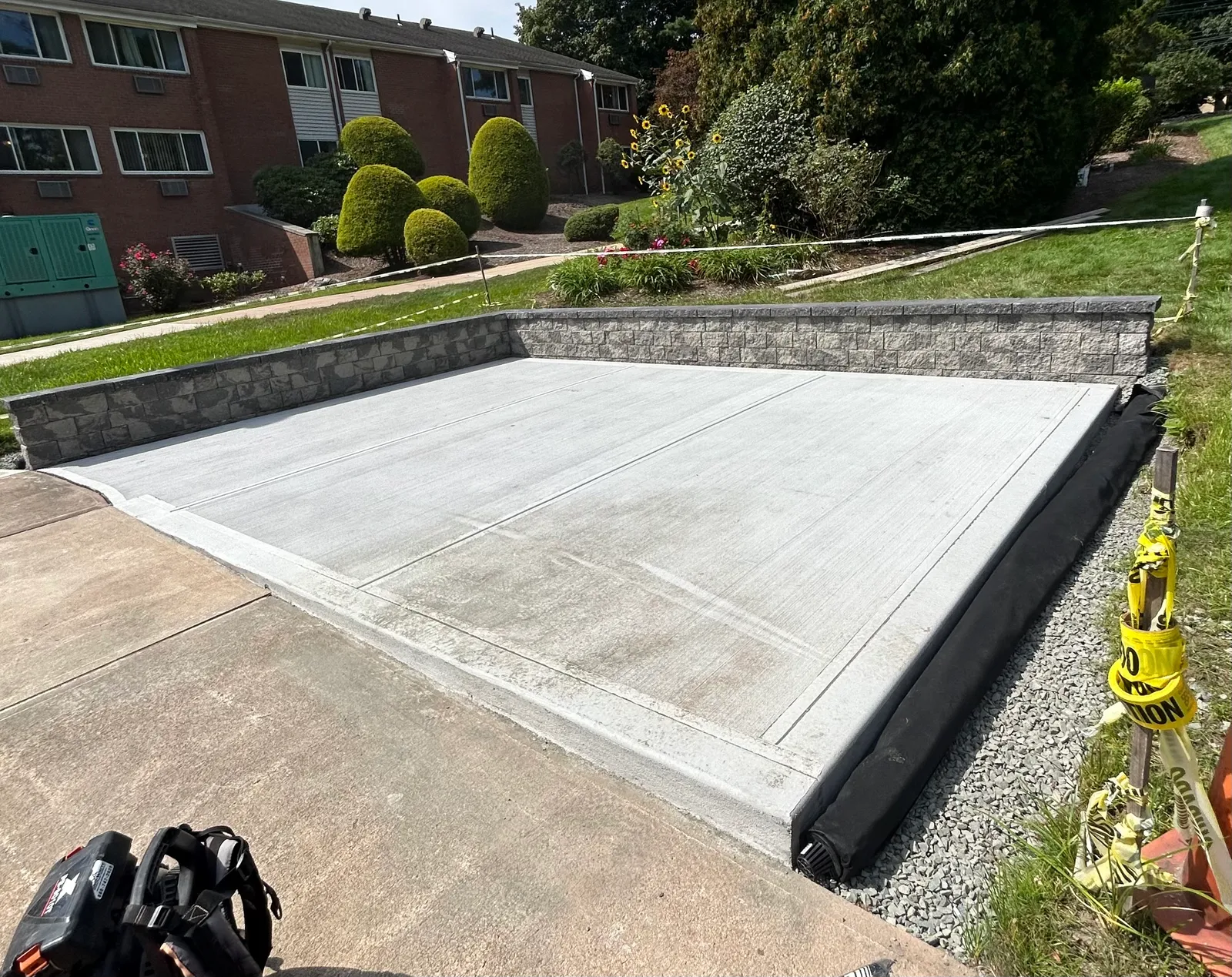
If you're planning a backyard patio in Connecticut, the first real decision isn't the color or the pattern. It's the material: a poured concrete slab or interlocking concrete pavers. Both can look great the day they're finished. The difference shows up three, five, ten winters later. Here's the honest comparison we give homeowners at the kitchen table, including the times we tell them concrete is the smarter buy.
Start with the ground, because our winters run the show
Every patio decision in Hartford County comes back to one fact: our ground doesn't sit still. Water in the soil freezes, expands, and pushes up. Then it thaws and drops back down. That cycle repeats dozens of times between November and March. We call it freeze-thaw, and it's the single biggest reason patios fail here that wouldn't fail in a warmer state.
So before we compare the two materials, understand what they're up against. Anything you build on this soil is riding on top of ground that moves all winter. The question is whether your patio moves with it or fights it.
Poured concrete: rigid, and that's the catch
A poured slab is one solid, continuous piece. That's its strength and its weakness. When the ground heaves under a rigid slab, the slab can't flex to absorb it. Something has to give, and concrete gives by cracking. Control joints help steer where the cracks go, but they don't stop the movement. Give a Connecticut slab enough winters and you'll usually see a crack somewhere.
The harder problem is what happens after. A cracked slab is very difficult to fix invisibly. You can fill the crack, but the patch never matches the surrounding concrete in color or texture, and the same movement that cracked it once will often reopen it. If a section heaves or settles unevenly, your realistic options are grinding, an overlay, or tearing it out and repouring. There's no clean, seamless repair.
Pavers: many small pieces that move together
Interlocking pavers take the opposite approach. Instead of one rigid slab, you get dozens or hundreds of individual units locked together and set on a flexible, compacted base of crushed stone and bedding sand. When the ground moves, the base and the joints between pavers absorb it. The patio flexes instead of cracking.
And when something does go wrong, the fix is clean. If a few pavers settle after a hard winter, our crews lift that small area, correct the base underneath, and reset the same pavers. No seam, no color mismatch, no scar. If a single unit gets stained or chipped, we pull it and drop in a replacement. That repairability is the paver's real advantage in a climate like ours, and it's the reason we usually lean this direction for patios meant to last.
A poured slab fights the frozen ground and cracks. A paver patio moves with it, and anything that settles can be lifted and reset without a scar.
Upfront cost vs. lifecycle cost
Here's where we're going to be fair to concrete: it's usually cheaper to install. Poured concrete is often the lower number on the estimate, sometimes meaningfully lower. Pavers cost more upfront because there's more labor, a deeper engineered base, and more material.
But the sticker price isn't the whole story. Think about the cost over the life of the patio. A slab that cracks in year six and needs an overlay or a tear-out gets expensive fast, and you may end up paying twice for the same patio. A paver patio you can maintain and spot-repair for decades. So while concrete often wins on day one, pavers frequently win on lifecycle cost, the total you spend over fifteen or twenty years.
- Poured concrete: lower upfront cost, faster install, fewer moving parts, but rigid, prone to cracking here, and hard to repair invisibly.
- Pavers: higher upfront cost, flexible base that handles freeze-thaw, individually repairable and replaceable, more design options, stronger resale.
Looks and resale
On appearance, pavers simply give you more to work with: a wide range of colors, patterns, textures, and edge details, from tight modern lines to a weathered, old-world look. That variety tends to add more to curb appeal, and a well-built paver patio generally does more for resale than a plain slab. Buyers read it as a finished, permanent feature.
Concrete isn't limited to gray, either. Stamped and colored concrete can mimic stone or brick for less than pavers, and some homeowners love it. Just know the tradeoff: stamped concrete is still concrete. It can still crack, and when it does, the stamped pattern makes a seamless repair even harder. You're buying the look, not the freeze-thaw performance.
Maintenance over the years
Neither option is zero-maintenance, but the work is different. Concrete asks for periodic sealing and, eventually, crack repair you'll be able to see. Pavers ask for occasional joint sand top-up and, every so often, a reset of any section that's settled. We've written more elsewhere on keeping pavers looking sharp and on sealing and joint sand, but the short version is that paver maintenance is mostly small, routine, and it keeps the patio genuinely restorable rather than just patched.
Where concrete still makes real sense
We won't pretend pavers are always the answer. Concrete is the right call more often than the paver industry likes to admit. If your budget is tight and the choice is a poured slab now versus no patio for two years, a slab you enjoy today can be the sensible move. Certain crisp, minimal modern designs are built around large uninterrupted concrete planes that pavers can't replicate. And for pure utility, a shed pad, an AC pad, a basic walkway out of sight, poured concrete is often the practical, economical choice. Good contractors recommend it when it fits.
The crew's rule
The base and the installer matter more than the material. A paver patio on a lazy base will heave, and a concrete slab poured right on well-drained, properly compacted subgrade can outlast a bad paver job. Ask any contractor how deep they're digging, what they're compacting, and how they handle drainage before you ask about color.
The bottom line
For most Connecticut backyards built to last, pavers on a proper engineered base are the better long-term call. They handle our freeze-thaw ground, they repair cleanly, and they hold their value. Concrete still earns its place on tight budgets, certain modern looks, and utility slabs, and it's often cheaper on day one. But whichever you choose, spend your energy vetting the base and the crew, not just the material. That's what decides whether your patio is still flat and solid ten winters from now.
Thinking about a project this season?
Free, no-pressure on-site quotes across Hartford County, CT.
Let's build something that lasts.
Hardscaping, landscaping and snow removal across Hartford County, Connecticut. Licensed (HIC.0703177) and fully insured — free quotes on every project.