How much does a paver patio cost in Connecticut?
Most installed paver patios in our area run $25–$45 a square foot — but the real number depends on the base, the material, and the site. Here’s what actually drives the price.
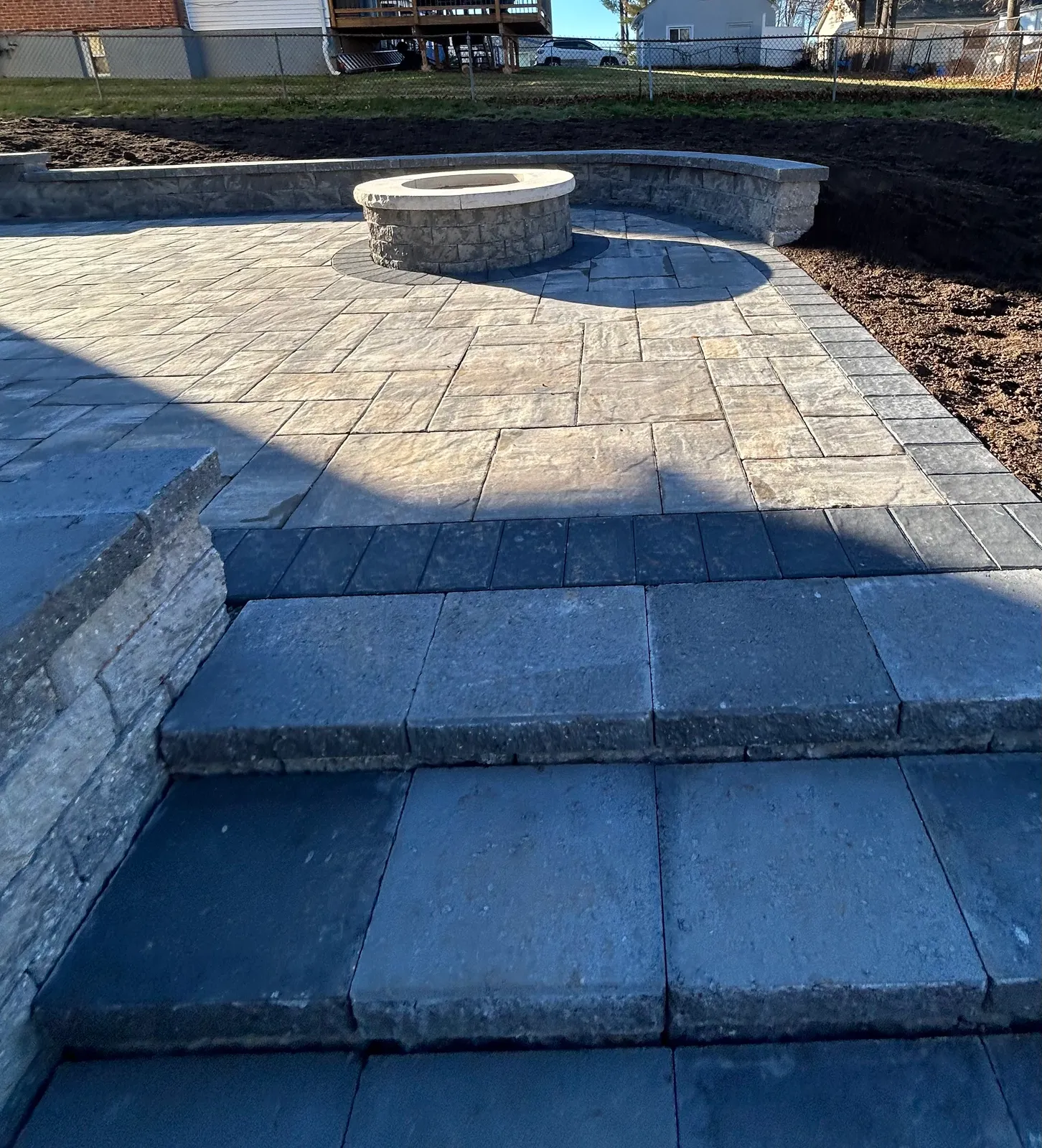
It's the first question almost every homeowner asks us, and it's a fair one. The honest answer is that most installed paver patios in our area run roughly $25 to $45 per square foot, but that range exists for a reason. What you're really asking is where your project lands inside it — and that comes down to a handful of things we can only nail down by standing in your backyard.
The short answer, with a real example
Let's make that range concrete. Take a straightforward 300-square-foot patio — a common size, enough room for a table and a few chairs. At the low end, around $25 a square foot, you're looking at roughly $7,500. At the high end, closer to $45, that same footprint runs about $13,500. Same square footage, big spread. That's not us hedging. It's the difference between standard concrete pavers on a simple, flat, easy-to-reach site and a premium architectural paver with a fire pit, a seat wall, and a tricky slope to deal with.
A small, simple, single-level patio sits at the bottom of the range. A large multi-level build that starts turning into an outdoor living space sits at the top. Most projects land somewhere in the middle. But a per-square-foot number is a starting point for the conversation, not a quote. Every quote we give is free, done on-site, and fixed in writing — because the real number lives in the details below.
What actually drives the price
When you compare two quotes and they're thousands of dollars apart, it's almost never because one contractor is greedy and the other is generous. It's because they're building different patios. Here's what moves the number:
- Size and square footage. The biggest single factor. More area means more material and more labor — though very small patios can actually cost a bit more per foot, because the fixed costs of showing up, excavating, and hauling get spread over fewer feet.
- Paver material tier. Standard concrete pavers sit at the low end. Premium architectural pavers — brands like Techo-Bloc or Nicolock — cost more but hold color and shape better over time. Natural stone is higher still. This is the choice most homeowners think about first, but it's rarely the biggest swing in the total.
- Site prep — the part you'll never see. Excavation, base depth, grading, and drainage. This is the foundation under everything, and in Connecticut's freeze-thaw climate it's what decides whether your patio still looks new in ten years or heaves in two. More on this below, because it matters more than most people realize.
- Added features. Steps, seat walls or retaining walls, a built-in fire pit, low-voltage lighting, curves, borders, and custom patterns. Each one adds material and skilled labor. A patio with three of these is a different animal than a plain rectangle.
- Site access and material handling. If we can back equipment right up to the work area, great. If every wheelbarrow of base and every pallet of pavers has to be walked through a narrow side yard or around the house by hand, that's real labor, and it shows up in the price.
Why the base is where the money really goes
Here's the thing homeowners don't see on the finished patio, and the thing that separates a good install from one that fails: what's underneath. A proper patio in this part of Connecticut is mostly base and labor. We excavate down, lay and compact several inches of crushed stone in lifts, set a bedding layer, and get the grading right so water runs away from your house and off the surface instead of pooling under it.
Do that right and the patio moves as one solid mass through every freeze and thaw. Cut corners on it — a thin base, skipped compaction, no attention to drainage — and water gets in, freezes, expands, and lifts. That's when you get the wavy, tilting, gap-riddled patio you've probably seen in a neighbor's yard. And here's the frustrating part: a thin base fails just as fast under expensive pavers as it does under cheap ones. You can't buy your way out of a bad foundation with nicer stone.
You're paying for the base and the labor as much as the stone on top of it.
Why the cheapest bid is usually a warning
When one quote comes in noticeably below the others, ask yourself where the savings are hiding. Nobody gets pavers or labor at half price. So if the number is dramatically lower, something got cut — and it's almost always the base, because that's the one part the homeowner can't inspect once the pretty pavers are down. The patio looks identical on install day. The difference shows up in the second or third winter, and by then the low bidder is long gone.
We're not telling you to always pick the highest number either. We're telling you to read the quotes closely. A cheap patio and a cheap-looking quote aren't the same thing. The cheapest bid is rarely the cheapest patio once you count the tear-out and rebuild down the road.
The crew's rule
If a quote doesn't spell out excavation depth, base thickness, and how water gets away from the house, it isn't a quote — it's a guess. Get those three things in writing before anyone breaks ground.
How to read a quote so you can actually compare
A good quote is itemized. You should be able to see the paver line, the base and excavation line, any features like a wall or fire pit, and the labor — not one lump sum with a shrug. Watch out for vague "allowances," where the contractor pencils in a placeholder dollar amount for materials you'll pick later. That's how a number creeps up after you've signed. When we quote, the price is fixed: the number on the paper is the number you pay, barring something genuinely unknown like ledge we couldn't have seen underground, which we'd flag and discuss with you before doing anything.
Comparing apples to apples means making sure each contractor is quoting the same base, the same paver tier, and the same features. Two bids on "a patio" tell you nothing. Two bids on the same fully-specified patio tell you everything.
The bottom line
Plan on roughly $25 to $45 per square foot installed, know that your spot in that range depends on size, material, site prep, features, and access, and remember that the invisible base is where longevity is won or lost. A real number for your yard needs eyes on your yard — the slope, the soil, the access, what you actually want. Our estimate is free, on-site, itemized, and fixed in writing, with no vague allowances. Ask us to come out, and we'll give you a number you can trust and explain every line of it.
Thinking about a project this season?
Free, no-pressure on-site quotes across Hartford County, CT.
Let's build something that lasts.
Hardscaping, landscaping and snow removal across Hartford County, Connecticut. Licensed (HIC.0703177) and fully insured — free quotes on every project.